

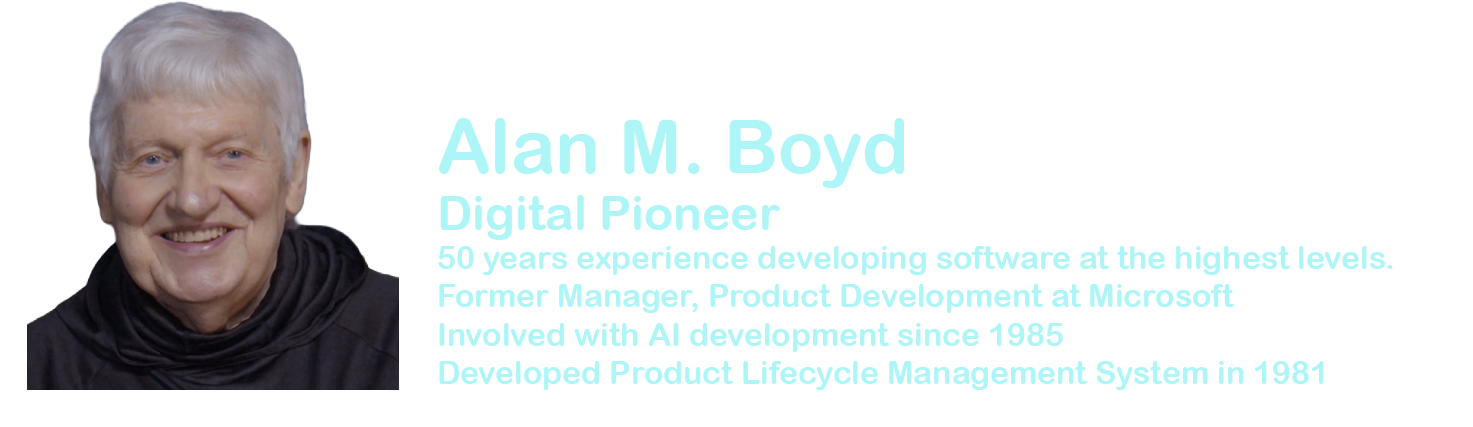
Meet the Wizard
In 1980, Alan M. Boyd joined Microsoft as Head of Product Development. Microsoft had just signed a contract with IBM to develop the software for their world-changing IBM PC that would be introduced in August 1981. This left Boyd with as many as 25 products in development. To manage this mammoth task, he designed his Product Lifecycle Management System (PLMS), an entirely new way of thinking about software. The results are there for all to see. Microsoft products introduced in the 1980s are still on the market today, four decades later, many still with dominant global market share in the world’s most competitive industry. These products have sold billions of units and earned revenues in the trillions of dollars.
Now Alan M. Boyd is ready to teach others the secret of his success.
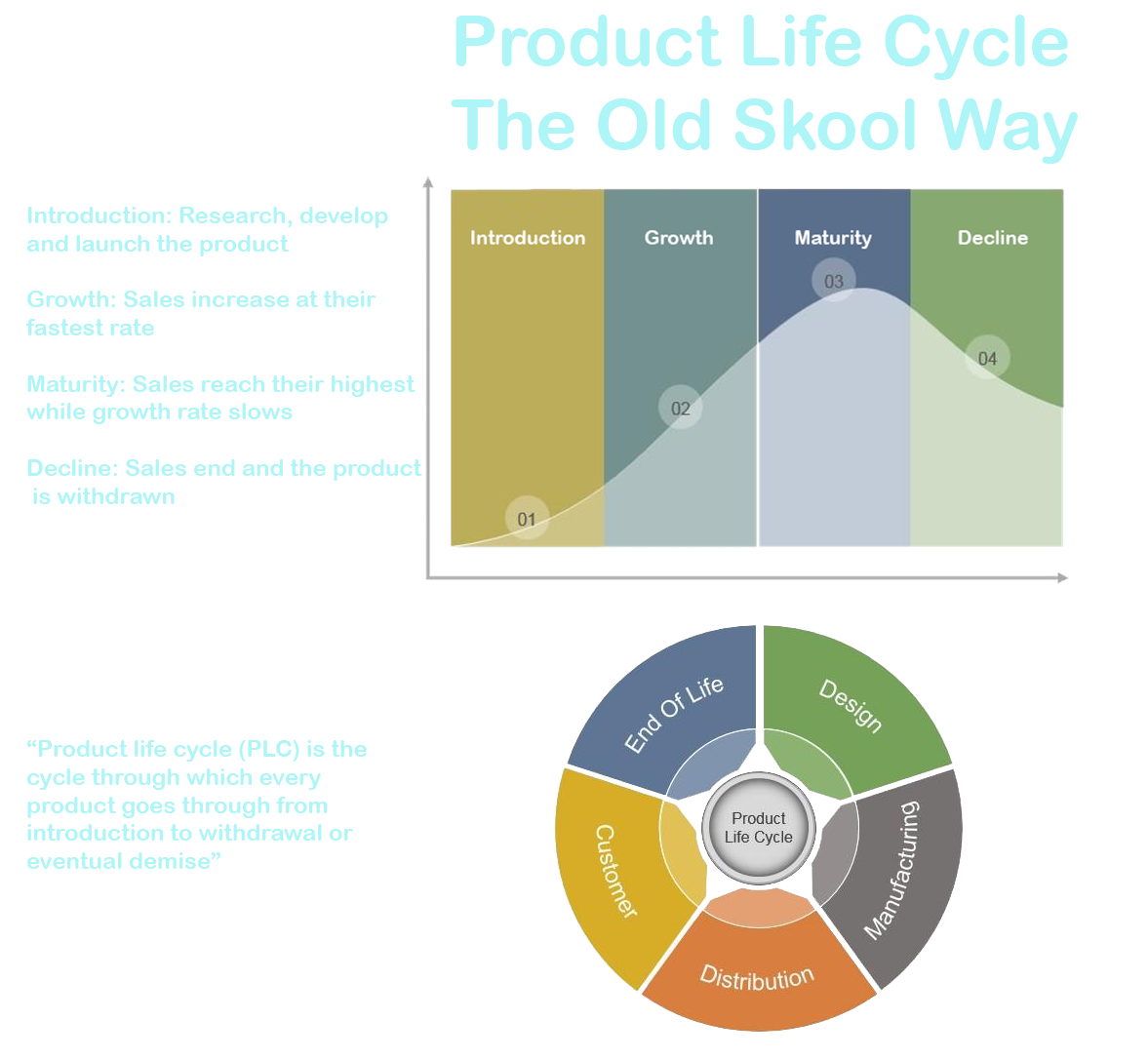
Business schools teach the Product Life Cycle as if it were a universal law of markets: a product is born, it grows, it matures, and eventually it declines. In the classroom, the model is presented as a smooth, predictable arc that every product inevitably follows. It’s tidy, it’s intuitive, and it fits beautifully on a whiteboard. The model’s appeal lies in its simplicity. It gives managers a sense of order in what can otherwise feel like a chaotic marketplace.
But the simplicity that makes the Product Life Cycle so teachable is the same simplicity that makes it increasingly out‑of‑date, especially when applied to software. The model was created in an era of physical goods, when products were manufactured, shipped, consumed, and eventually replaced. A shampoo bottle or a car model genuinely does move through a linear sequence of introduction, growth, maturity, and decline. Once it reaches the end of its life, it disappears from the shelves and is replaced by something new. The lifecycle is a one‑way journey.
Software does not behave this way. A software product is not a static object that enters the world fully formed. It is a living system that evolves continuously. The moment it is released, it begins a cycle of updates, refinements, redesigns, and expansions. New features can reignite growth long after the product is supposedly “mature.” A shift in customer behaviour or a new integration can reposition the product entirely. Even a complete redesign can occur without ever withdrawing the product from the market. In other words, software does not move along a line; it loops.
This looping behaviour breaks the logic of the traditional lifecycle. In software, decline is not a terminal stage but a signal that the product needs to be re‑examined, re‑imagined, or re‑engineered. A product that appears to be fading can be revived with a new interface, a new business model, or a new set of capabilities. The idea that a software product must inevitably die is simply not true. Many of the most successful digital products have reinvented themselves multiple times, each reinvention creating a fresh cycle of growth.
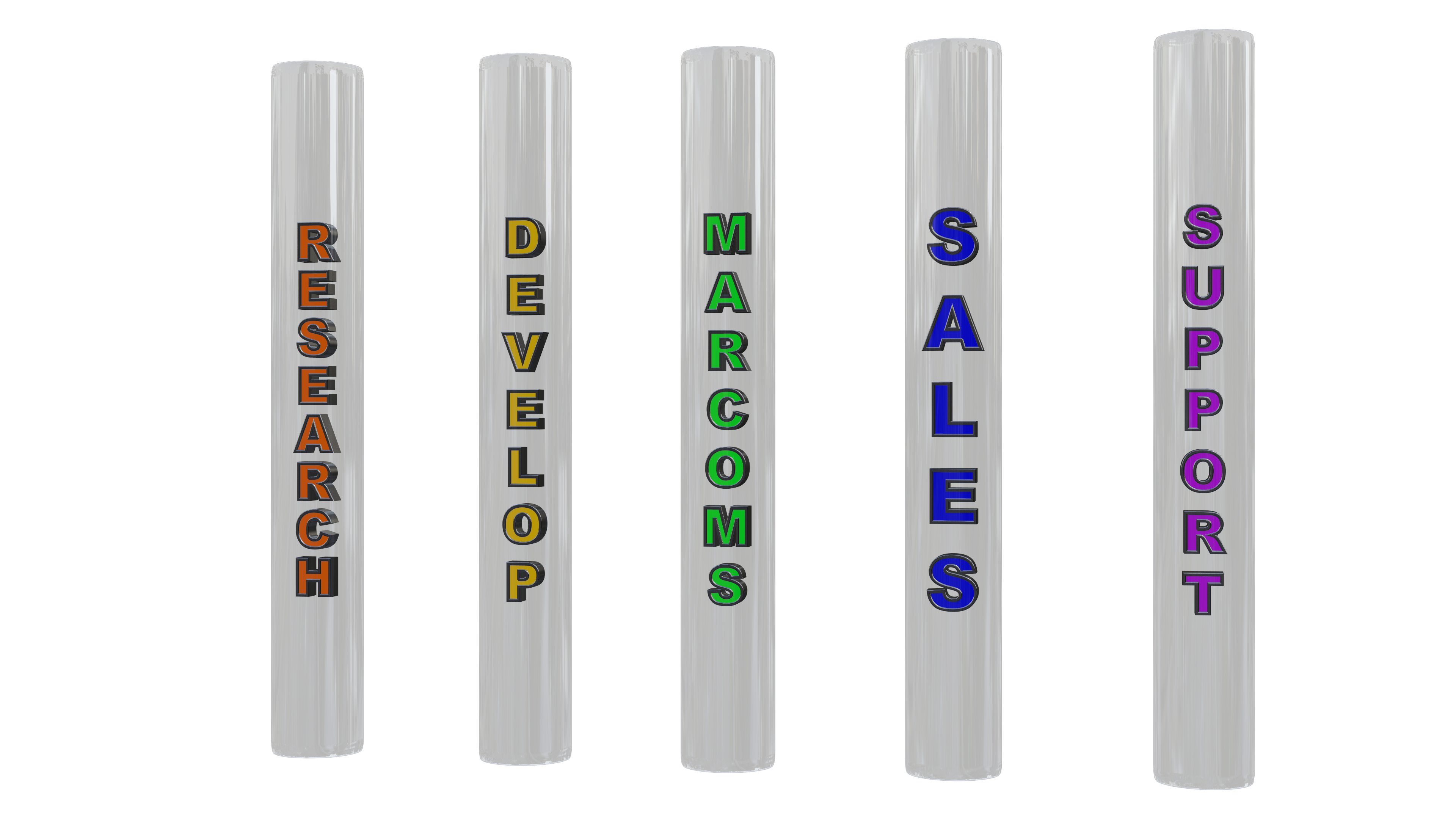
The 5 Silos of Software Business
In any software company, the work tends to fall naturally into five distinct silos: Research, Development, Marketing Communications, Sales, and Customer Support. Each of these groups sees the product from a different angle, and each contributes something essential to its success.
Research is where ideas begin. It is the part of the organisation that tries to understand what customers need, what problems are worth solving, and what opportunities are emerging in the market. Development takes those insights and turns them into working software, translating possibilities into features, interfaces, and systems that people can actually use. Once the product exists, Marketing Communications steps in to explain it to the world, shaping the story, the positioning, and the language that helps customers understand why the product matters. Sales then takes that story and turns it into revenue, working directly with customers to match the product to their needs and to close deals. Finally, Customer Support lives with the product after it has been sold, helping users succeed, resolving issues, and seeing firsthand where the product delights and where it falls short.
Although these five silos often operate as if they are separate, the reality is that they form a continuous loop. The most important connection in that loop is the one that runs from Customer Support back to Research. Customer Support gathers the next wave of feedback. And the cycle begins again.

The Software Product Lifecycle is not Linear
When you’re dealing with software, it’s far more accurate to visualise the product lifecycle as a circle rather than a straight line. A linear model suggests a beginning, a middle, and an inevitable end, but software doesn’t behave that way. It evolves continuously, looping through discovery, development, communication, delivery, and learning. Each release generates new insights, each insight becomes the seed of the next version, and customer feedback constantly reshapes what the product needs to become. Seeing the lifecycle as a circle captures this rhythm of renewal. It shows that software doesn’t march toward decline; it cycles through improvement, reinvention, and growth again and again.
Products like Microsoft Word, Excel, and Windows have not only avoided decline for decades — they have grown, expanded, and reinvented themselves through continuous cycles of research, development, communication, sales, and customer feedback. Each new version has been shaped by what users struggled with, what they asked for, and what emerging technology made possible. These products didn’t follow a one‑way path from launch to maturity and then fade away; they looped through cycle after cycle of improvement, renewal, and expansion. Their longevity is the clearest evidence that software thrives through iteration, not linear progression, and that the true lifecycle of a software product is a circle that turns every time new insight sparks the next evolution.
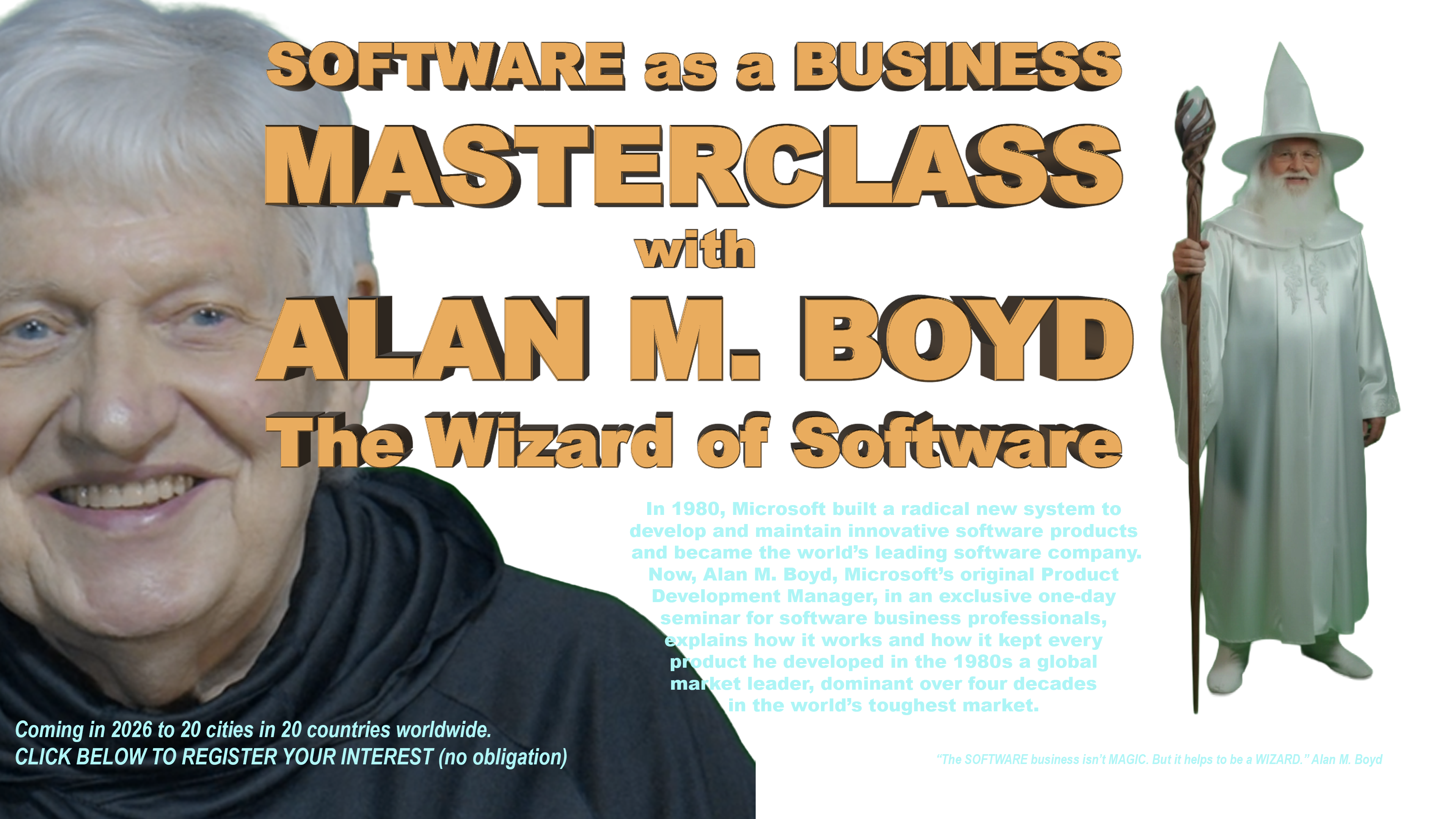
Software is a business. And to be good at it, companies need to learn all the other aspects besides writing the code. This is exactly what my Product Lifecycle Management System does.
While most software products survived a few years – products developed using PLMS have survived longer than 40 years, sold billions of copies and generated trillions in revenues. In the world’s most competitive industry.
I’m opening PLMS up for the rest of the world to use. In the coming months I’m planning a global Wizard of Software MasterClass tour, a series of one-day seminars to introduce professional software developers to PLMS. I’ll personally tutor small groups of professionals how to apply and use PLMS to manage their products the same way we did at Microsoft in its high-growth days.
Each MasterClass will be a one-day seminar for exclusive audiences of no more than 10 held in cities around the world.
AI WRITES CODE. SOFTWARE ALONE IS NO LONGER ENOUGH.
Alan M. Boyd
Register your interest.
MasterClasses are limited to a maximum of 10 attendees.
MasterClasses are currently being scheduled for the following cities:
London, Paris, Dublin, Amsterdam, Geneva, Tampere, St Petersburg, Nairobi, Cape Town, Lagos, Hyderabad, Rio de Janiero, Sydney, Vancouver, Singapore, Kuala Lumpur, Tokyo, Bangkok, Hong Kong, Shenzhen, Beijing.
Additional cities will be included should there be sufficient interest.
This information will be used for scheduling purposes only.
Register your interest for the upcoming PLMS MasterClass. We will contact you with dates and venue details for your region.